Static Residential Proxies vs Rotating Residential Proxies Which One Fits Your Workflow Better
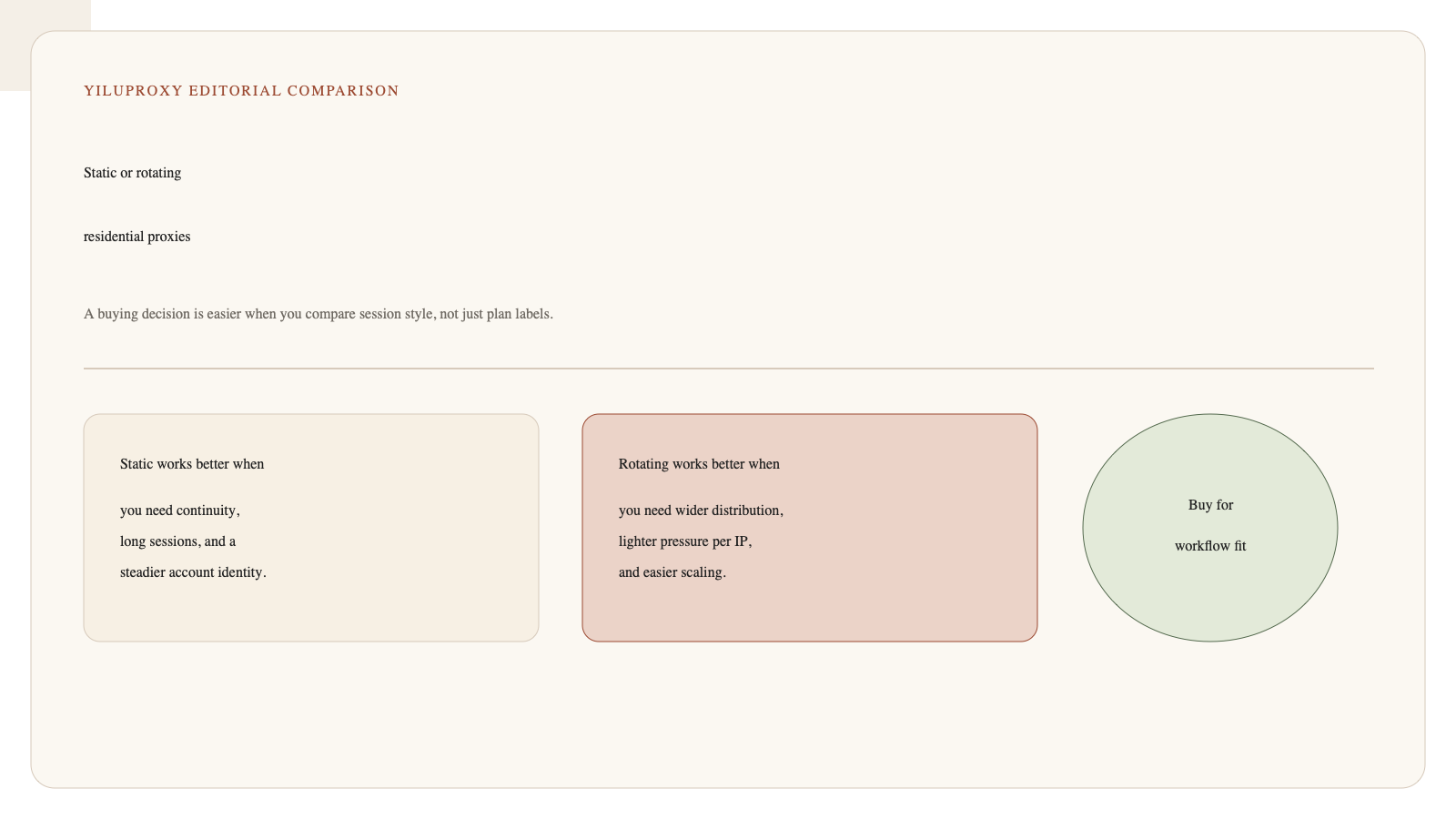
If you are choosing between static residential proxies and rotating residential proxies, the real question is not which one is better in general. It is which one fits the way your workflow behaves. Some tasks need a long, consistent identity. Others work better when IPs change automatically to reduce pressure on a single session. Once you look at the job this way, the choice becomes much easier.
For most buyers, static residential proxies are better when account stability, login consistency, and long sessions matter more. Rotating residential proxies make more sense when you need broader distribution, lighter pressure per IP, and smoother scaling across repeated requests. The key is to match the proxy type to the session pattern, not just the price sheet.
If you are still comparing plans, it helps to review real Static Residential Proxies and Rotating Residential Proxies side by side before you commit to a larger purchase.
What static residential proxies are best at
Static residential proxies keep the same residential IP for a longer period. That makes them a strong fit for workflows where consistency matters more than constant IP refresh. If a platform expects repeated logins, longer sessions, familiar device behavior, or lower identity drift, a static option usually feels more natural.
- Account management: useful when you do not want the IP to change too often.
- Long session tasks: better for dashboards, seller tools, and repeated account actions.
- Stable location needs: helpful when region continuity matters.
- Lower environment churn: easier to troubleshoot because fewer variables are changing.
This is why many buyers choose static residential proxies for account-heavy work instead of starting with a rotating pool by default.
What rotating residential proxies are best at
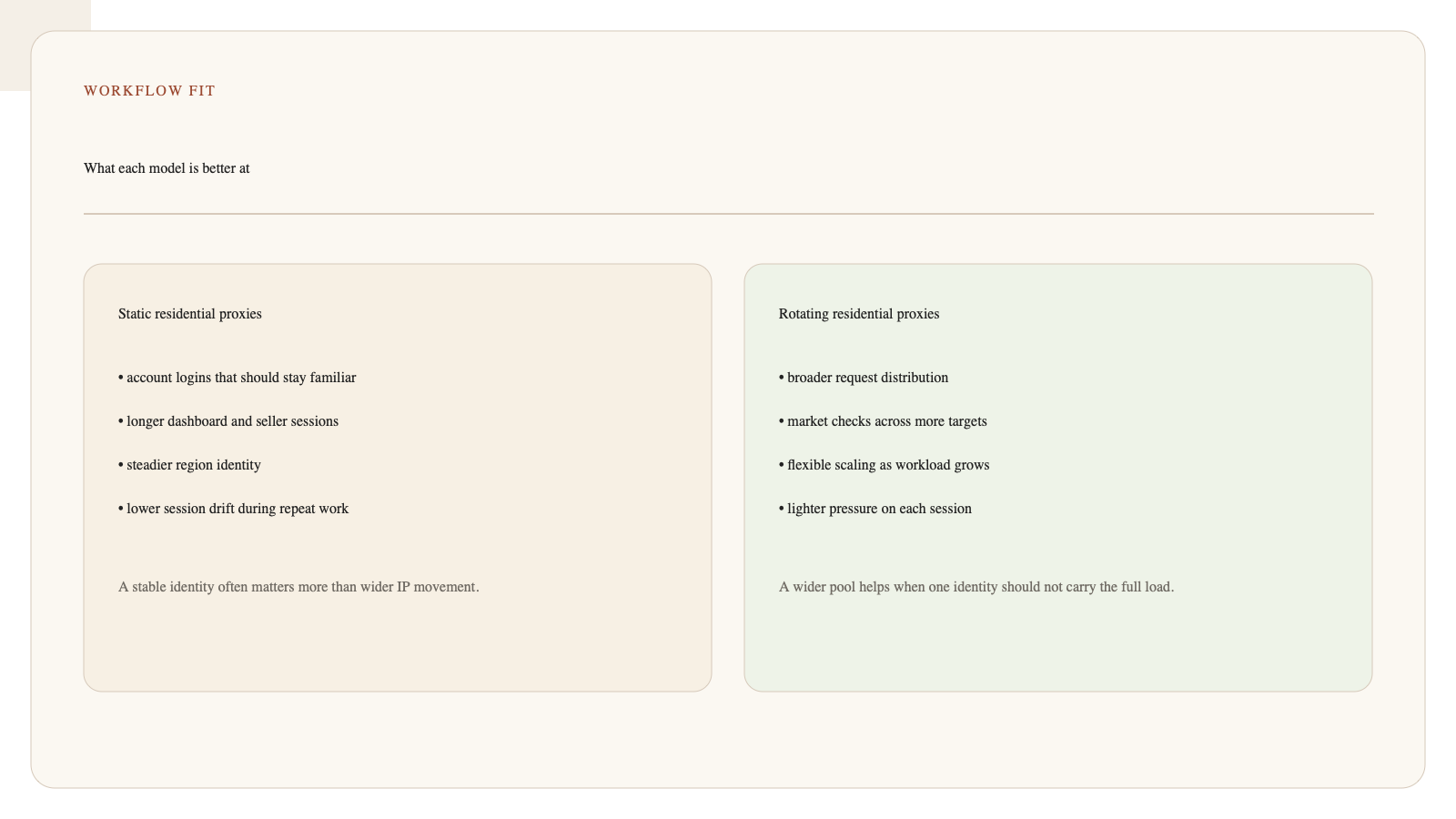
Rotating residential proxies change IPs on a schedule or by request rule. That makes them more suitable for workflows that spread requests across a wider pool instead of asking one identity to handle everything. If your volume is higher or your task naturally benefits from distribution, rotating IPs usually give you more flexibility.
- Large-scale data collection: useful when request load needs to be distributed.
- Broad market checks: better when you need more coverage across locations.
- Testing across many sessions: easier when one IP does not need to carry the whole workload.
- Elastic scaling: often more practical when volume changes week to week.
For buyers who care about coverage and scale first, rotating proxy options are usually easier to expand without redesigning the whole setup later.
How to decide based on session behavior
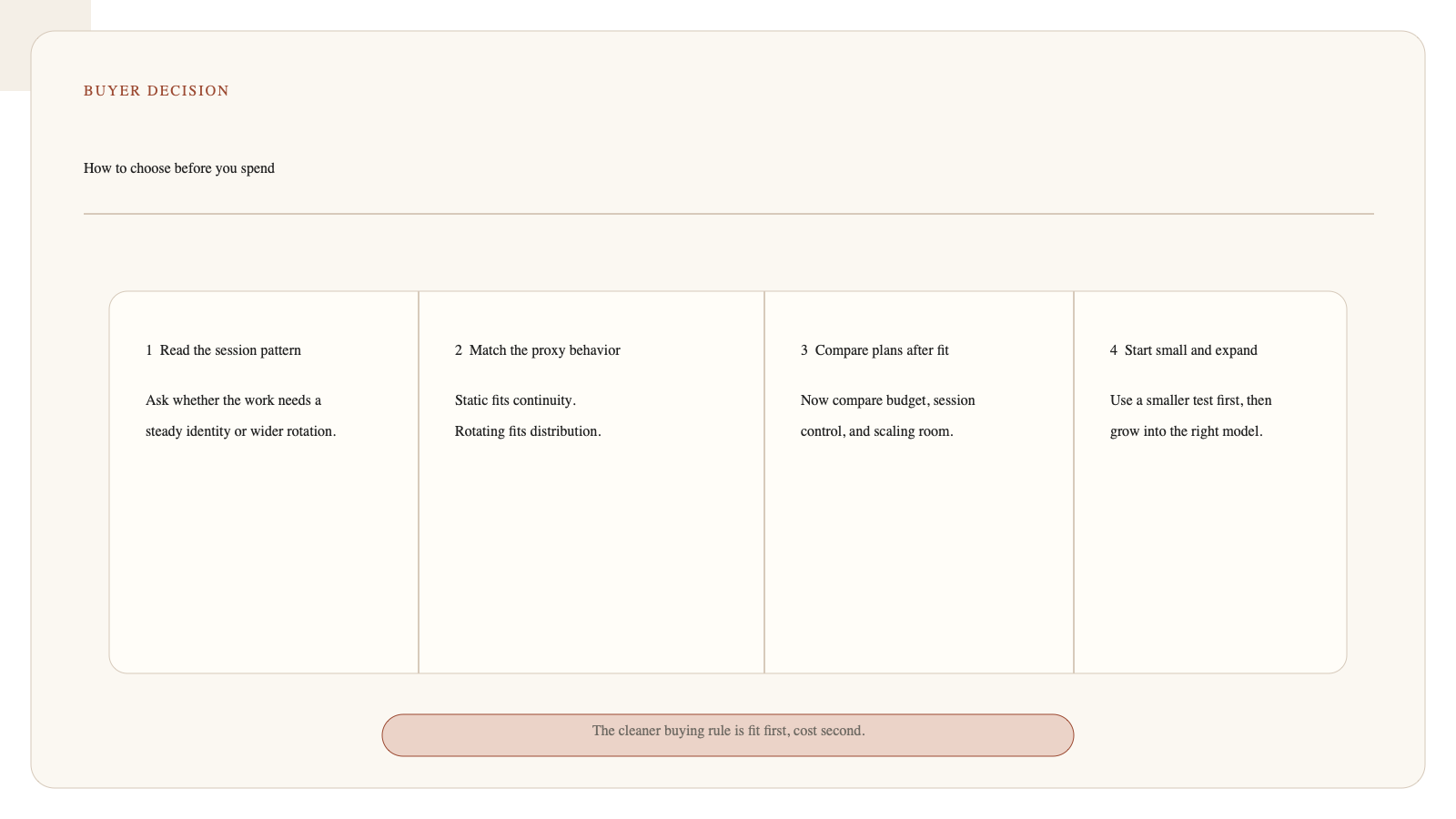
The fastest way to choose is to ask one simple question: does your task need session continuity or session distribution?
- Choose static residential proxies when the same account, device pattern, or working session should stay steady.
- Choose rotating residential proxies when your requests should be spread out so no single IP carries too much activity.
Many teams get poor results because they buy for the wrong pattern. They use rotating IPs for tasks that need continuity, or static IPs for workloads that really need distribution.
What buyers usually get wrong before purchasing
The most common mistake is treating all residential proxies as one category. In practice, the purchase decision is often about control style, not just IP source. A residential IP can look high quality on paper and still be the wrong fit if the session model is wrong for the workload.
- Only checking price per GB or per IP without checking session needs
- Focusing on pool size only without asking how long sessions need to last
- Choosing static for convenience when the workload is actually too broad
- Choosing rotating for safety when the accounts need a steadier identity
That is why YiluProxy usually frames the choice around workflow fit first, then cost. A cheaper plan that forces more retries, more account resets, or more manual fixes is rarely the cheaper option in real use.
When static residential proxies make more sense
- You manage long-lived accounts.
- You want cleaner login continuity.
- You care about holding one region for a longer session.
- You want fewer moving parts during setup and testing.
If that sounds like your workflow, a smaller but steadier static residential proxy plan is often the better starting point.
When rotating residential proxies make more sense
- You spread requests across many pages, items, or targets.
- You need easier scaling without keeping one IP for too long.
- You expect volume spikes.
- You care more about coverage and throughput than long session identity.
In those cases, a rotating pool usually gives you more room to grow and less pressure on any single IP path.
What to compare before you buy
Before choosing one type, compare these points instead of only looking at headline pricing:
- Session duration: how long do you need to hold identity?
- Traffic pattern: are you repeating actions or distributing requests?
- Geographic need: do you need one steady region or wider rotation?
- Scaling plan: are you running a stable workflow or an elastic one?
- Operational cost: which option creates fewer manual fixes later?
For buyers who are still unsure, provider documentation can help ground the basics. Cloudflare’s explanation of request context is one reminder that consistency matters in many networked workflows, while MDN’s overview of HTTP behavior helps explain why session and request patterns change outcomes even when the destination is the same.
Frequently asked questions
Are rotating residential proxies always better for avoiding blocks
No. They are better for some request patterns, but they are not automatically better for account tasks or long sessions that benefit from continuity.
Are static residential proxies too limited for growth
Not necessarily. They can work very well for stable, account-based workflows. The limitation appears when the workload needs broader distribution rather than identity consistency.
Should I buy both types
Sometimes yes. Many teams end up using static residential proxies for account continuity and rotating residential proxies for larger request distribution. The best mix depends on how your workflow is split.
Conclusion
Static residential proxies vs rotating residential proxies is not a simple better-or-worse decision. Static options are usually stronger for continuity, long sessions, and account stability. Rotating options are usually stronger for scale, distribution, and flexible request handling. If you choose based on session behavior first, the purchase decision gets much clearer.