Do You Really Need Overseas Dynamic Residential IPs for Stable Global Access?
Overseas dynamic residential IPs are often marketed as the “default” solution for global access: more natural traffic, more locations, fewer blocks. Sometimes that’s true. But many teams buy dynamic residential pools expecting “stability,” then discover the opposite: more churn, more variance, more random failures—and higher costs.
The counterintuitive reality is this:
Dynamic residential IPs are great for coverage and risk distribution. They are not automatically great for stability.
Stable global access is usually achieved by consistency and control:
- consistent geo signals
- predictable latency (especially p95/p99)
- stable session behavior
- clear rotation boundaries
This article answers one question: do you really need overseas dynamic residential IPs for stable global access, and if not, what should you use instead? It also shows how teams typically use YiLu Proxy with a lane approach: dynamic residential where distribution helps, static/dedicated where continuity matters, and datacenter where performance needs to be predictable.
1. What “stable global access” actually means
1.1 Stability is mostly about consistency, not “trust”
Platforms and services tend to reward coherent signals:
- same region over time
- predictable session behavior
- fewer mid-session changes
Even “trusted” IPs become unstable if your network identity changes constantly.
1.2 The metrics that define stability
If you want stable access across regions, track:
- success rate per target and per region
- p95/p99 latency and jitter (not just average)
- timeout rate and handshake failure rate
- verification/CAPTCHA frequency (for login flows)
- retry cost (retries per successful request)
1.3 Not all “global access” is the same workload
Global access usually breaks into lanes:
- SESSION: logins, long-lived sessions, account actions
- OPS: operational checks, localized rendering validation
- COLLECT/MONITOR: stateless checks, public endpoints, monitoring
Each lane has different stability needs.
2. What overseas dynamic residential IPs are best at
2.1 Coverage and distribution
Dynamic residential pools shine when you need:
- many countries/cities
- lots of unique exits
- distribution of stateless traffic
They’re often used for localized QA and coverage-style validation.
2.2 Risk spreading for non-session workloads
For stateless requests, distribution helps:
- reduce concentration on one IP
- lower per-IP rate pressure (when combined with throttling)
- reduce “single exit burned” events
2.3 Accessing strict targets that penalize datacenter ranges
Some sites treat datacenter ranges as “guilty until proven innocent.” In those cases, residential exits can improve reach—especially for public browsing and light interactions.
3. Why dynamic residential can be unstable (and when it hurts)
3.1 Exit quality variance is the hidden tax
Dynamic pools contain exits with different:
- latency
- packet loss/jitter
- routing behavior
Under concurrency, a few bad exits can poison an entire run with timeouts and retries.
3.2 Frequent IP changes can break session coherence
For workflows that look “human-consistent” (logins, dashboards), dynamic churn can trigger:
- forced re-auth
- step-up verification
- session resets
In these workflows, “more residential” does not equal “more stable.”
3.3 Cost rises faster than stability when you scale
When dynamic variance causes retries, you pay twice:
- proxy usage costs more
- compute time and operator time cost more
The real cost metric is cost per successful completion, not cost per GB.

4. When you truly need overseas dynamic residential IPs
4.1 You need broad geo coverage and the workload is mostly stateless
Examples:
- region-by-region content checks
- public page validation across many countries
- ad preview checks at scale
Dynamic residential pools provide the breadth.
4.2 Targets aggressively block datacenter ranges and require residential signals
If your target blocks DC hard and you must reach many regions, dynamic residential is often the pragmatic tool—provided you control pacing and validate exits.
4.3 You’re doing distribution-heavy, rotation-friendly tasks
If the task tolerates exit churn (no long sessions), dynamic residential is appropriate.
5. When you do NOT need dynamic residential (better alternatives)
5.1 For stable logins and long-lived sessions: use static/dedicated residential
If stability is the goal, static residential often wins:
- fewer verification prompts
- less session breakage
- coherent region identity
A small set of stable IPs can outperform a huge rotating pool for account workflows.
5.2 For high-concurrency monitoring and stateless automation: use datacenter
When identity is not the key and performance matters, datacenter exits often deliver:
- lower and more consistent latency
- clearer failure modes (429/403 vs random timeouts)
- better cost per successful request
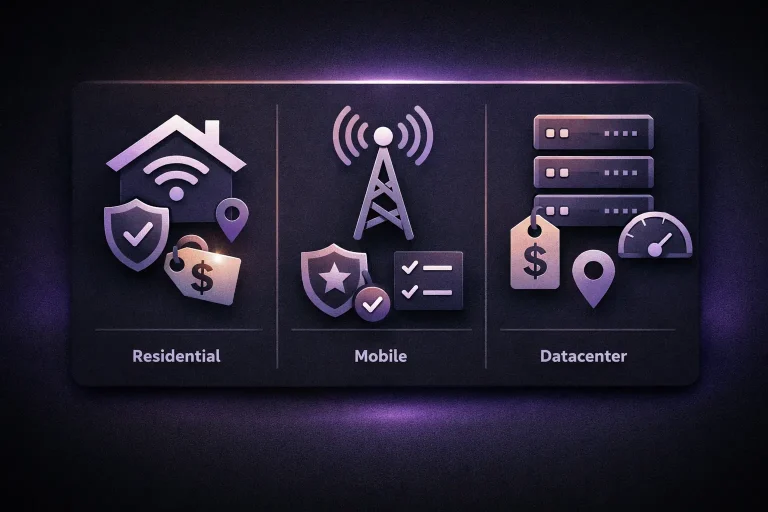
5.3 For predictable global operations: use lanes, not one pool
A mixed strategy is often best:
- dynamic residential for coverage checks
- static residential for session lanes
- datacenter for monitoring and pipelines
6. A simple decision framework you can copy
6.1 Choose overseas dynamic residential IPs when
- the workload is stateless and rotation-friendly
- you need broad geo coverage
- targets penalize datacenter ranges heavily
- you can validate exits and throttle per host
6.2 Choose static/dedicated residential when
- sessions must stay stable
- you manage accounts or dashboards
- you want fewer verification prompts
- you need region continuity for identity-sensitive flows
6.3 Choose datacenter when
- tasks are high-concurrency and repeatable
- you care about predictable p95 latency
- you can control pacing and accept clear rate limits
7. Where YiLu Proxy fits
Stable global access usually comes from assigning the right IP type to the right lane. YiLu Proxy fits this approach well because teams can:
- run dynamic residential pools for broad global coverage checks
- reserve static/dedicated residential exits for stable SESSION workflows
- use datacenter pools for scalable monitoring and stateless automation
- keep lanes separated so noisy traffic doesn’t contaminate session stability
The practical outcome is fewer “random failures,” because stability is engineered through consistency and lane boundaries—not purchased by buying the biggest rotating pool.
You don’t need overseas dynamic residential IPs just to achieve stable global access. You need them when your workload is rotation-friendly and coverage-heavy, or when targets demand residential signals across many regions.
For stability-first workflows, dynamic churn can be the enemy. Use static residential for continuity, datacenter for predictable high-concurrency tasks, and dynamic residential for coverage. Build a lane model, measure p95/p99 and retries per success, and global access becomes infrastructure—not guesswork.